
Florida Amendment 3 Explained: What Homeowners and Home Buyers Need to Know
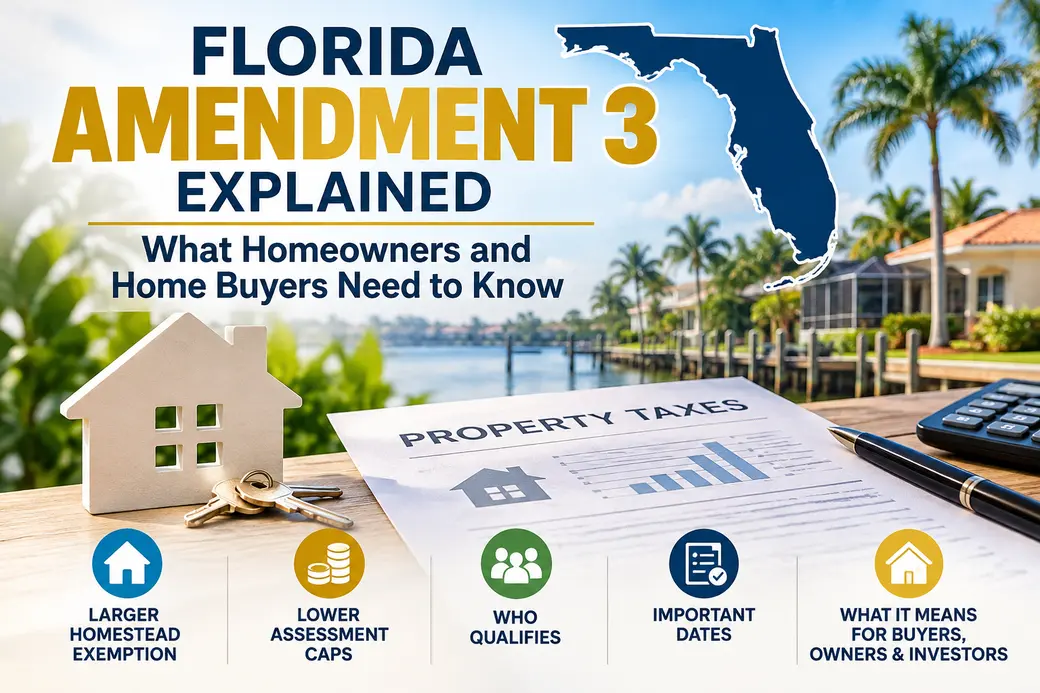
If you live in Florida, or you're thinking about buying a home here, you've probably started hearing a lot about Amendment 3 and property taxes.
And if you're confused, you're certainly not alone.
I've heard everything from “Florida is eliminating property taxes” to “Everyone is getting a $250,000 tax break.” Neither explanation tells the whole story.
Amendment 3 is on Florida's November 2026 ballot, and it could make significant changes to the way certain properties are taxed. But there are several important details homeowners, buyers, investors, landlords, and people considering a move to Florida need to understand.
So, rather than getting caught up in the political noise, let's look at what Amendment 3 actually proposes and what it could mean for Florida property owners.
What Is Florida Amendment 3?
Amendment 3 is a proposed amendment to the Florida Constitution dealing with both homestead and non-homestead property taxes.
If approved by voters, one of the biggest changes would be an increase in the homestead exemption that applies to taxes levied by taxing authorities other than school districts.
The exemption would increase to:
-
$150,000 beginning in 2027
-
$250,000 beginning in 2028
-
Beginning after that, the amount would be adjusted annually for inflation when applicable.
The amendment would also reduce the annual assessment increase cap for certain non-homestead properties from 10% to 5%.
If approved, Amendment 3 would take effect January 1, 2027.
First, What Exactly Is a Homestead Exemption?
This is where I think some of the confusion begins.
Florida's homestead exemption is available to qualifying homeowners who make a Florida property their permanent residence. It reduces the property's taxable value for certain property taxes.
That's very different from reducing the market value of your home or handing a homeowner money.
Florida already provides homestead exemptions under the state constitution. Amendment 3 proposes significantly increasing the portion of assessed value exempt from non-school property taxes.
Does a $250,000 Homestead Exemption Mean You Save $250,000?
No. This may be the biggest misconception surrounding Amendment 3.
A $250,000 exemption does not mean the government gives you $250,000.
It doesn't mean your property tax bill goes down by $250,000 either.
The exemption reduces the portion of your home's assessed value that is subject to certain property taxes.
For example, if a qualifying property has an assessed value high enough to take advantage of the full exemption, a larger portion of that assessed value could be excluded when certain non-school taxes are calculated.
Your actual savings would depend on several factors, including your property's assessed value, the exemptions you qualify for and the tax rates imposed by the applicable local taxing authorities.
That means two Florida homeowners may not see exactly the same dollar savings.
Does Amendment 3 Eliminate Property Taxes in Florida?
No.
Amendment 3 is not a proposal to eliminate all property taxes in Florida.
It changes exemptions and assessment limits that determine how some property taxes are calculated.
Homeowners could still have property tax obligations even if Amendment 3 passes.
That's an important distinction because “property tax relief” and “no property taxes” are two very different things.
What Happens to School Property Taxes?
This is another important detail.
The increased homestead exemption under Amendment 3 applies to non-school taxes.
In other words, the proposed $150,000 and eventually $250,000 exemption would not simply be deducted when calculating school district property taxes.
The existing Florida homestead structure treats school and non-school levies differently, and Amendment 3 continues that distinction.
So when you're estimating what Amendment 3 could save you, you shouldn't simply take $250,000 off your home's assessed value and calculate your entire property tax bill from the remaining amount.
What Happens If You Already Have Florida Homestead Exemption?
This is especially important for current Florida homeowners.
Under the amendment, qualifying homeowners who are Florida residents by December 31, 2026 would generally be positioned to receive the increased exemption as it phases in, provided they continue to meet the applicable homestead requirements.
That December 31 date matters because the amendment treats some people who establish Florida residency later differently.
What If You're Moving to Florida After 2026?
This is one of the provisions I believe people considering a move to Florida need to pay particularly close attention to.
Under the ballot language, someone who is not a Florida resident on December 31, 2026 could still qualify for Florida's existing homestead exemption after establishing an eligible Florida homestead.
However, the increased exemption proposed by Amendment 3 generally would not begin until the fifth year of homestead exemption eligibility, to the extent permitted under the U.S. Constitution.
That means someone moving to Florida in the future should not assume that buying a primary residence automatically gives them the same expanded exemption immediately.
For people considering relocating to Fort Myers, Cape Coral, Bonita Springs, Estero or elsewhere in Southwest Florida, that's an important part of the equation when planning future housing expenses.
What About Save Our Homes?
Amendment 3 and Florida's Save Our Homes benefit are related to property taxes, but they aren't the same thing.
Save Our Homes limits how much the assessed value of a qualifying homestead property can increase annually after the property receives homestead exemption.
A homestead exemption, on the other hand, reduces the amount of assessed value subject to certain taxes.
Think of them as two different pieces of Florida's property-tax system:
Homestead exemption: reduces taxable value.
Save Our Homes: limits increases in assessed value for qualifying homesteaded property.
Understanding that distinction is especially important when comparing the tax bill of someone who has owned a home for years with what a new buyer might pay.
Why Can't a Buyer Simply Use the Seller's Current Property Tax Bill?
This is something I regularly explain to buyers.
The property tax amount you see on a listing or county tax record is based on the current owner's situation, not necessarily what you'll pay after purchasing the property.
The current owner may have:
-
Homestead exemption
-
Years of accumulated Save Our Homes benefits
-
Other exemptions
-
A much lower assessed value based on their ownership history
After a sale, the property will be reassessed according to Florida law.
That's why I always caution buyers against using the seller's current tax bill as their future tax estimate.
And if Amendment 3 passes, understanding the difference between assessed value, taxable value, homestead exemptions and residency dates becomes even more important.
What Does Amendment 3 Do for Rental Homes and Investment Properties?
There's another part of Amendment 3 that hasn't received nearly as much attention as the $250,000 homestead exemption.
The amendment proposes reducing the annual assessment increase cap on certain non-homestead properties from 10% to 5%.
Non-homestead property can include properties such as:
-
Rental homes
-
Second homes
-
Vacation properties
-
Commercial real estate
-
Other qualifying non-homestead real property
This does not turn these properties into homesteaded properties or give them the expanded homestead exemption.
Instead, it would limit how quickly their assessed value could increase annually under the applicable constitutional cap.
That's potentially significant for Florida investors and property owners who don't use a property as their primary residence.
Would Renters Benefit From Amendment 3?
This one isn't as straightforward.
Renters don't receive a homestead exemption on a property they don't own.
Supporters of Amendment 3 argue that lowering the assessment-growth cap on rental properties could give landlords more predictable property-tax expenses and potentially reduce some upward pressure on rents.
However, that does not guarantee that a landlord will reduce rent or that rents won't increase.
Rental prices are influenced by many factors, including insurance, maintenance, HOA fees, supply and demand, financing costs and market conditions.
So I would be careful about interpreting Amendment 3 as a direct tax break for renters.
What Could Amendment 3 Mean for Local Governments?
This is another part of the discussion that deserves attention.
Property taxes help fund local government operations and services. Increasing exemptions can reduce the taxable value available to certain taxing authorities.
The exact impact would vary among Florida counties and municipalities based on their tax base, budgets and other factors.
Amendment 3 also contains provisions governing how counties and municipalities may use property-tax revenue, including categories such as public safety, infrastructure, natural resources, debt service and government operations.
How individual communities respond to changes in property-tax revenue is something homeowners should continue watching if the amendment passes.
Is Amendment 3 Just for Retirees?
No.
Florida has separate property-tax provisions that can provide additional benefits to certain qualifying seniors, but Amendment 3 itself isn't simply a senior-citizen exemption.
Its homestead provisions apply based on homestead and residency requirements rather than being limited to retirees.
That means working families, younger homeowners and retirees could potentially qualify.
Does Amendment 3 Affect Second Homes?
Yes, but differently from primary residences.
A second home generally does not qualify for Florida homestead exemption because homestead status is tied to permanent residency.
Therefore, the proposed expanded homestead exemption wouldn't normally apply to a vacation or second home.
However, the proposed reduction of the non-homestead assessment cap from 10% to 5% could potentially apply.
This distinction is particularly important in Southwest Florida, where we have many second homes, seasonal residences and investment properties.
What Happens If Amendment 3 Passes?
If at least 60% of Florida voters approve Amendment 3, the constitutional amendment would take effect January 1, 2027.
The increased homestead exemption would begin at $150,000 in 2027 and increase to $250,000 in 2028, with inflation adjustments thereafter.
Other provisions, including the lower assessment-growth cap for non-homestead properties, would also take effect according to the amendment and implementing law.
What Happens If Amendment 3 Doesn't Pass?
Florida's current constitutional property-tax system would remain in place unless changed through another law or constitutional amendment.
Existing homestead exemptions, Save Our Homes protections and other current property-tax provisions would continue under existing law.
What Should Southwest Florida Homeowners and Buyers Take Away From All of This?
The biggest thing I want homeowners and buyers to understand is that Amendment 3 is not as simple as “a $250,000 tax exemption.”
There are several moving parts.
It matters whether the property is your primary residence.
It matters when you establish Florida residency.
School and non-school property taxes are treated differently.
Investment and second-home properties are treated differently from homesteaded properties.
And a property's market value, assessed value and taxable value are three different numbers that shouldn't be used interchangeably.
Whether you ultimately support or oppose Amendment 3 is your decision. My goal is simply to help Southwest Florida homeowners and future buyers understand what they're actually voting on, and how Florida's property-tax system can affect the real cost of owning a home.
Thinking About Buying or Selling a Home in Southwest Florida?
Property taxes are only one part of the cost of owning a home in Florida.
Insurance, flood zones, HOA and condo fees, CDD fees, special assessments and property taxes can all affect what a home really costs each month.
If you're buying or selling in Fort Myers, Cape Coral, Estero, Bonita Springs, Fort Myers Beach, North Fort Myers, Alva, Sanibel or the surrounding Southwest Florida area, I can help you look beyond the listing price and understand the costs and considerations that come with the property.
Billee Silva, REALTOR®
Century 21 AllPoints Realty
Doing Everything but the Packing!
Categories
- All Blogs 402
- 55+ Communities 12
- Boating Communities 13
- First Time Home Buyer 144
- Flood Insurance 3
- Florida Lifestyle 69
- Foreclosures 2
- Fort Myers Market Update 5
- Fun Things to do in Lee County, Florida 37
- Golf Communities 23
- Home Buyer Tips 165
- Home Seller Tips 123
- Homeowner Tips 64
- Mortgage Tips 44
- Neighborhoods 72
- Schools 3
- Title & Escrow 4
- Title Insurance 5
Recent Posts




GET MORE INFORMATION

Billee Silva, PA, ABR SRS
Licensed Realtor License ID: P3275278
Licensed Realtor License ID: P3275278